 EN
EN DE
DE FR
FR IT
IT ES
ES 中国
中国 BR
BR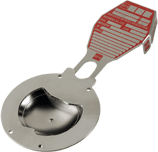 |
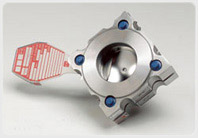
LPS Reverse Buckling Disk |
U.S. patents 5,996,605 and 6,178,983 apply. Other patents pending.
The Low Pressure LPS™ Reverse Buckling Disk and SRB-7RS Safety Head
LPS Rupture Disk (Bursting Disc) Features:
- Solid Metal Design
- Low burst pressure from 5 psig (0.35 barg)
- Designed for gas, liquid or two phase service
- Fail Safe: Damage Safety Ratio ≤1
- Designed for non-fragmentation
- Vacuum/back pressure resistant
- High Operating Ratio: 90% of Minimum Burst Pressure
- Reverse Buckling Disk in sizes: 1"-8" (25 mm-200 mm)
- For installation in BS&B type SRB-7RS pre-torqued safety head
The LPS Rupture Disk (Bursting Disc) was developed to provide low burst pressures from 5 psig (0.35 barg) using reverse buckling rupture disk technology. The LPS Rupture Disk (Bursting Disc), combined with the SRB-7RS® Safety Head, provides accuracy and reliability. The LPS uses SAF™ technology (Structural Apex Forming™) enabling very low burst pressures to be achieved with excellent opening characteristics.
LPS Rupture Disk (Bursting Disc) Material Options
The LPS Rupture Disk (Bursting Disc) is available in a range of corrosion resistant materials (see table on opposite page for details).
Standard disk materials are Nickel alloy 200, Stainless Steel grade 316, Inconel® (Nickel alloy 600), Monel® (Nickel alloy 400), Hastelloy® C-276, & Tantalum.
The LPS disk includes an outlet side hinge to control fragmentation. Standard disk hinge material is Stainless Steel grade 316 with alternates available upon request. Tef liners are offered with the type LPS Rupture Disk (Bursting Disc) at burst pressures of 35 psig (2.4 barg) and higher.
Flow Performance/KR Values/Rupture Disk (Bursting Disc) Sizing
Flow resistance factor, "KR," may be used to determine the relieving capacity of a
system when using techniques such as those described in Crane Technical Paper No. 410. Individual KR values have been established for both gas & liquid service for the LPS disk. These are experimentally determined at the BS&B Safety Systems, L.L.C. flow laboratory following ASME procedures and witnessed by ASME representatives. Care must be taken to use the correct value for sizing purposes. When KR values are marked on the LPS disk tag, those for gas service are shown as "KRg," and those for liquid service are shown as "KRl."
When using KR value for sizing calculations, the nominal pipe size (assuming schedule 40 pipe), of the vent system is used. When using "coefficient of discharge" sizing techniques, the Minimum Net Flow Area or Net Relief Area of the rupture disk (bursting disc) device is used.
MNFA Values and NRA Values
| Disk Size | MNFA |
NRA |
|
in |
mm |
(in2) |
(cm2) |
1 |
25 |
0.86 |
4.90 |
1 1/2 |
40 |
1.93 |
11.30 |
2 |
50 |
3.36 |
19.70 |
3 |
80 |
7.39 |
40.80 |
4 |
100 |
12.74 |
69.70 |
6 |
150 |
28.89 |
158.60 |
8 |
200 |
50.00 |
275.60 |
MNFA is expressed in square inches to facilitate sizing calculations in line with ASME practices. NRA is expressed in square centimeters for use when sizing in line with ISO, European Standards and forthcoming CEN practices.
Operating Pressure Ratio (Maximum Operating Pressure)
LPS Reverse Buckling Disks can be operated to 90% of their minimum burst pressure. In other words, to 90% of the marked burst pressure less the burst tolerance.
Vacuum Resistance/Back Pressure Resistance
The LPS disk will resist vacuum without the need for an additional vacuum support. Back pressure resistance is limited to 15 psig (1.03 barg) for disks rated to burst at 15 psig (1.03 barg) or less. For higher burst pressures, back pressure resistance is equal to the minimum burst pressure of the ordered LPS disk.
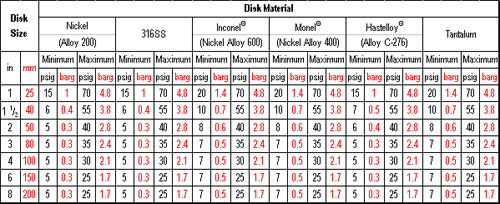
Burst Pressure Capability at 72ºF (22ºC)
Maximum Recommended Temperature
Hastelloy is a trademark of Haynes International Inc., Monel and Inconel are trademarks of Inco Alloys International. BS&B may use equivalent materials from other sources.
Material |
Temp ºF |
Temp ºC |
Nickel Alloy 200 |
750º |
399º |
Monel® Alloy 400 |
900º |
482º |
Inconel® Alloy 600 |
1100º |
593º |
316 Stainless Steel |
900º |
482º |
Hastelloy® Alloy C-276 |
900º |
482º |
Tantalum |
500º |
260º |
Note: Consult BS&B for applications where the disk may be rated with a
coincident temperature below 300ºF/149ºC (176ºF/80ºC for Hastelloy) but operated at a higher value. Special processing may be required.
Cycle Resistance/Temperature Influence/Service Life
The cycle resistance of the LPS disk is a function of the application operating conditions. If the operating pressure is static, (without pressure cycles), then as for all types of rupture disk devices, the service life shall be maximized. If the operating pressure is mildly cyclic, such as the conditions of a sealed atmospheric tank under ambient temperature fluctuations, the LPS disk may resist in excess of 1000 cycles.
Under highly cyclic operating pressure conditions, the cycle life of the LPS disk is determined by the frequency and magnitude of pressure change from positive to negative differential. When all of the pressure cycling takes place within the operating pressure ratio of the LPS disk and at a positive differential pressure, the service life shall be maximized. Should the operating pressure cycle between full vacuum and positive pressure, the service life of the LPS disk can be anticipated at several hundred cycles.
Cycle and service life for every rupture disk (bursting disc) depends upon its unique application operating conditions. It is particularly important to allow for the temperature's influence on burst pressure; if the rated burst temperature of the disk is selected too low, a higher actual temperature may reduce the disk burst pressure. Seek advice from BS&B Safety Systems regarding rated burst temperature. Other application factors including corrosion, erosion, abrasion, product build-up and vibration, affect the service life of a rupture disk (bursting disc) and must be considered by the user.
BS&B Safety Systems has developed "Rupture Disk (Bursting Disc) Manager" as a service tool that uses "in service" pressure and temperature information to generate alerts regarding maintenance replacement of rupture disks (bursting discs). Contact BS&B for more information.
Burst Pressure Tolerance Options
The approach to LPS disk burst tolerance depends upon which International Code is being followed. For disks to comply with the ASME Code, please select a "manufacturing design range" and the "burst tolerance" applicable to the required burst pressure. For disks to comply with European or ISO standards, please select either a Performance Tolerance or a min/max burst pressure. Alternate larger tolerances are indicated where a cost savings can be offered.
Burst Tolerance
Burst tolerance is the +/- range of pressure over which a rupture disk (bursting disc) can be expected to burst. Burst tolerance is a function of LPS burst pressure, according to the table to the right.
Burst Pressure |
Burst Tolerance |
|
psig |
barg |
|
28 and higher |
1.93 and higher |
± 5% |
20 to < 28 |
1.38 to < 1.93 |
± 7% |
10 to < 20 |
0.69 to < 1.38 |
± 10% |
< 10 |
< 0.69 |
± 15% |
alternate: |
< 2.76 |
± 2 psig |
<40 |
|
(0.138 bar) |
Manufacturing Design Range (MDR)
Manufacturing design range is a range of pressure, always applied to the minus side of the user requested burst pressure for the LPS disk.
The standard LPS manufacturing design ranges are 0%, -5%, -10%. For Tantalum, the MDR options are -5% and -10% only.
Performance Tolerance
Performance tolerance is being introduced to European and ISO codes. It is applied to the specified burst pressure as a percentage or a pressure quantity and includes all tolerances (both burst tolerance and manufacturing design range). Performance tolerance can also be expressed as a min/max burst pressure as shown below.
Specified Burst Pressure |
PerformanceaTolerancea(standard)* |
|||
psig |
barg |
|||
28 and higher |
1.93 and higher |
±5% |
+5%/-10% |
+5%/-15% |
20 to <28 |
1.38 to <1.93 |
±7% |
+7%/-12% |
+7%/-17% |
10 to <20 |
0.69 to <1.38 |
±10% |
+10%/-15% |
+10%/-20% |
<10 |
<0.69 |
+10%/-20% |
+10%/-25% |
+10%/-30% |
alternate: |
±10% |
+10%/-15% |
+10%/-20% |
|
20 to <40 |
1.38 to <2.76 |
|
|
|
*Select one, special requests for Performance Tolerance accepted.
Minimum/Maximum Burst Pressure
Minimum/maximum burst pressure is being introduced by European and ISO codes. Taking the specified burst pressure, select the preferred performance tolerance & convert to a min/max value.
For example: specified burst pressure of 3 barg and selected performance tolerance of +5%/-10%. This equates to a min/max of:
Minimum burst pressure (3 x 0.9) = 2.7 barg min
Maximum burst pressure (3 x 1.05) = 3.15 barg max
Special requests for min/max burst pressure accepted.
Sanitary/Aseptic Option
The LPS-S™ disk is available for use in the SR-C™ Safety Head providing low burst pressures for disks to be installed into sanitary/aseptic piping systems. The table below indicates the relationship between disk size, safety head size and the tri-clamp connection sizes at the inlet, outlet and mid-flange where the disk is installed within the safety head.
LPS-S Disk Size |
SR-C Safety Head Size |
SR-C Safety Head at Inlet |
SR-C Clamp Size at Disk |
SR-C Safety Head at Outlet |
1" |
1" |
1 1/2" |
2" |
1 1/2" |
1 1/2" |
1 1/2" |
2" |
2 1/2" |
2" |
2" |
2" |
3" |
4" |
3" |
3" |
3" |
4" |
4" |
4" |
4" |
4" |
4" |
6" |
4" |
Installation in SRB-7RS™ Safety Head
The LPS disk installed in an SRB-7RS™ Safety Head permits the correct torque to be applied in the workshop before installation into the process. The asymmetric locating pins ensure centering and orientation of the disk within the safety head. The performance-proven metal-to-metal "bite-type" seal in the safety head (2"/50 mm size and above) assures a leak-tight assembly. When installed properly into the SRB-7RS Safety Head, the assembly can be removed, inspected, cleaned carefully then reinstalled without replacing the disk as the pre-torqued cap screws maintain the clamp load on the disk.
The SRB-7RS Safety Head is used with other rupture disks (bursting discs) (types S-90™, JRS™, RLS™ and FRS™) of the STA-SAF® System, Catalog 77-4001. The use of a common safety head facilitates upgrading from these rupture disks (bursting discs) to the superior technology of the LPS Rupture Disk and its higher pressure companion, the SKR Rupture Disk (Bursting Disc); see catalog 77-4003.
Note: LPS disk petal is retained by the interaction of the disk hinge and the SRB-7RS™ Safety Head.
U.S. Patent 4,751,938 and other international patents pending.
Inconel® and Monel® are registered trademarks of Inco Alloys International. Hastelloy® is a registered trademark of Haynes International, Inc.
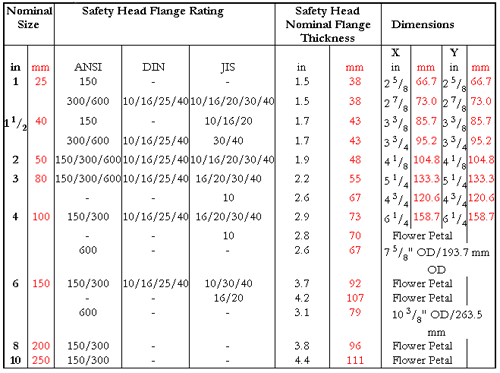
SRB-7RS Safety Head Dimensions
Related Products
For more information on other BS&B products, see Catalog 77-1010 for Burst Alert® Sensors compatible with the LPS Rupture Disk (Bursting Disc) and catalog 77-1016 describes the SmartDisk™ wireless rupture disk monitoring system. Refer to our websites to learn more.